
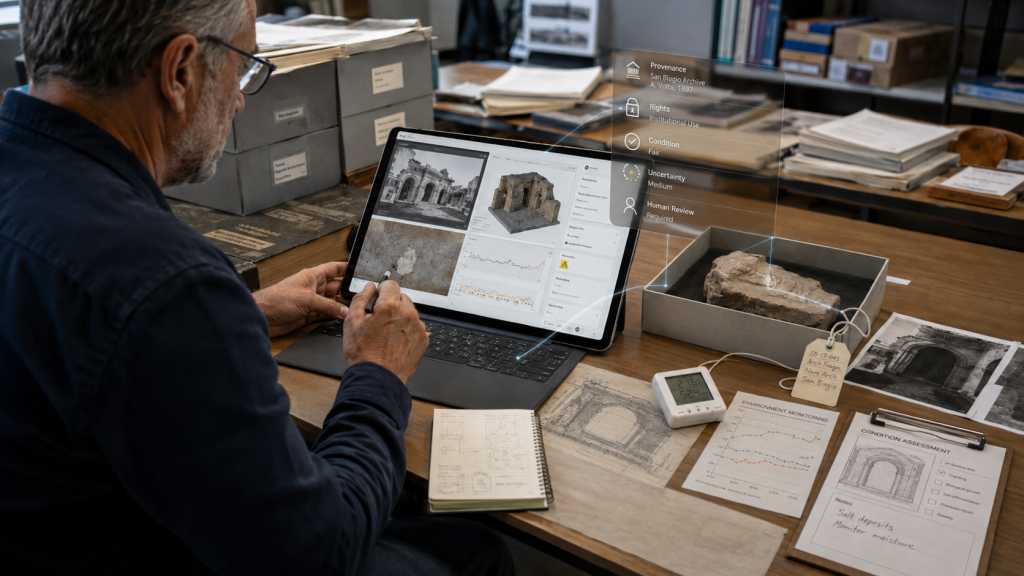
HERITWIN will test whether cultural digital twins can help heritage organisations connect scattered records, monitoring data and local knowledge without replacing professional judgement.
Cultural heritage organisations often hold information in many forms: photographs, catalogues, maps, inspection notes, conservation records, 3D scans, environmental readings and local knowledge. The problem is rarely a complete lack of data. More often, the material sits in different systems, follows different vocabularies, has uneven metadata or carries access restrictions that make reuse difficult.
HERITWIN starts from that operational problem. In this project, a digital twin should not be understood only as a visual model. It should be a structured representation of a heritage object, site or environment that can connect spatial data, documentation, metadata, sensor information and, where relevant, preparedness or conservation scenarios.
That distinction matters. A conservation decision may depend on physical condition, weather exposure, visitor pressure, earlier repairs, legal protection, staff capacity and available budgets. A digital twin cannot make those decisions on its own. Its role is to organise evidence so that curators, conservators, public authorities, researchers and local actors can see relationships that would otherwise remain spread across documents and databases.
The project will need to test the full workflow, not only the final interface. That means identifying the source data, preparing it for use, mapping it to recognised heritage standards where appropriate, connecting it to Cultural Heritage Cloud workflows, involving users, and recording where the method breaks down. The test is not whether a dashboard looks convincing; it is whether the information behind it is traceable, maintained and useful for a real decision.
Semantic data is central to this work because interoperability in cultural heritage is not just file exchange. A photograph, scan or sensor reading is useful only when users can understand what it represents, who created it, what rights apply, how accurate it is and how it relates to other records. HERITWIN should therefore preserve provenance, version history, rights information and uncertainty markers alongside the visible output.
The project’s decision-support theme should also stay disciplined. Claims about preparedness, predictive conservation or AI-assisted monitoring must be tied to defined use cases: for example, humidity patterns, flood exposure, structural stress, inspection planning or documentation quality. Where a model produces a suggestion rather than a verified fact, the output should be labelled as such and reviewed by people with the relevant heritage responsibility.
HERITWIN’s strongest contribution may be practical evidence about limits. A cultural digital twin may help institutions organise information and discuss risk, but it can also create new maintenance burdens.
If a workflow depends on specialist staff, proprietary tools, unclear data rights or constant manual updates, it may not be adoptable after the funded period. The pilots should make these constraints visible rather than hide them behind polished demonstrations.
Part 1 of the Heritwin project article can be read here: hafenstrom-to-coordinate-heritwin-a-new-european-cultural-heritage
 The HERITWIN project is funded by European Commission through Horizon Europe Cluster 2 2025 Heritage-03