
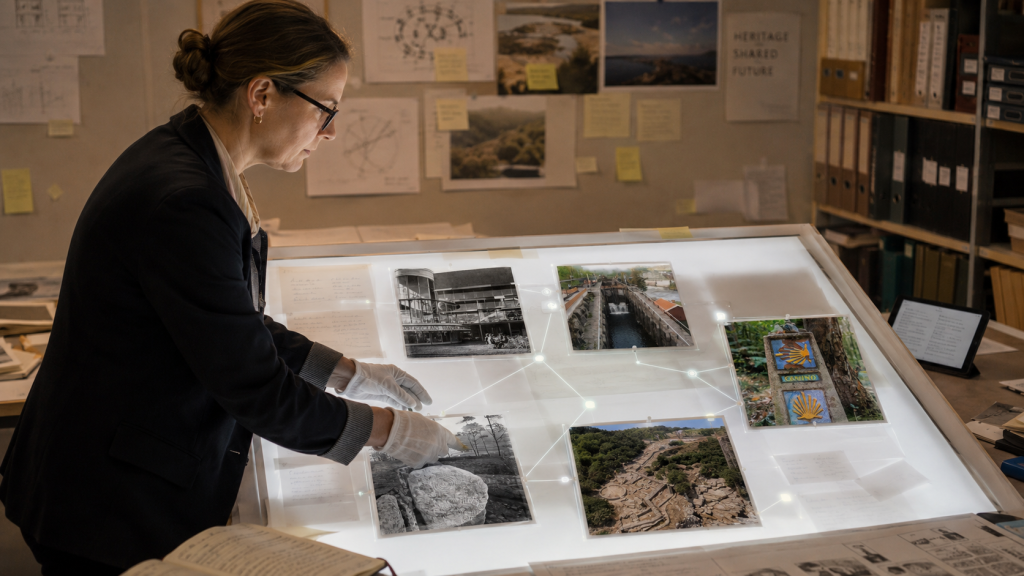
HERITWIN will test its approach in five heritage settings across Europe, using different data types and institutional contexts to see which digital twin workflows can be reused beyond one site.
HERITWIN will not test cultural digital twins in a single laboratory setting. The project is built around five pilots in Sweden, Norway, Spain, the United Kingdom and Greece. That spread matters because cultural heritage work does not follow one standard operating model. A museum archive, a canal landscape, a pilgrimage route, a fragile prehistoric monument and an archaeological interpretation setting create different data, staffing, rights and maintenance questions.
The Swedish pilot concerns the Stockholm Exhibition of 1930. The editorial focus should be on fragmented historical design and exhibition material: how archival sources, metadata and digital reconstruction can be connected so that institutions can interpret a temporary event whose buildings and displays no longer exist in their original form. The case is relevant because the 1930 exhibition is widely recognised as an important moment in Swedish modernism and functionalism.
The Norwegian pilot focuses on the Telemark Canal. It will test preparedness and predictive conservation in a heritage landscape where water, weather, infrastructure, tourism and public access intersect. The pilot should show whether GIS, building or infrastructure models, LiDAR, photogrammetry, sensor data and local knowledge can be connected in a way that supports inspection, risk assessment or maintenance planning.
The Spanish pilot is connected to the Camino de Santiago. Its role is platform validation: testing practical routes into digital heritage infrastructure for organisations that work with distributed cultural routes, community contribution, interpretation and tourism pressure. The pilot should make clear which users are being served and what evidence they need before digital outputs can be trusted.
The United Kingdom pilot concerns Knockmany Passage Tomb, also known as Annia’s Cove, in Northern Ireland. Public heritage information identifies it as a Neolithic passage tomb whose chamber stones include characteristic passage-tomb art. In HERITWIN, the pilot will test a sensor, edge and cloud workflow with attention to micro-climate monitoring and digital twin integration. That creates a useful stress test: environmental data must be collected and interpreted without adding unsustainable burdens for site managers.
The Greek pilot is based in Aphytos, Halkidiki. It will focus on archaeological documentation, semantic enrichment and XR interpretation. The editorial risk here is to overstate public-facing immersion before the evidence exists. The stronger framing is that the pilot will test how documentation and interpretation workflows can serve both expert use and public understanding, while keeping provenance and uncertainty visible.
Across all five pilots, the shared validation question is the same: can heritage data be prepared, connected, checked and reused in ways that remain meaningful outside the local pilot? HERITWIN’s answer should depend on evidence records, not presentation quality. Each pilot should document the data used, standards or mappings applied, user groups involved, rights constraints, maintenance needs and failures encountered.
Part 1 of the Heritwin project article can be read here: hafenstrom-to-coordinate-heritwin-a-new-european-cultural-heritage
Part 2 of the Heritwin project article can be read here: from-historic-records-to-decision-support-heritwin-project
 The HERITWIN project is funded by European Commission through Horizon Europe Cluster 2 2025 Heritage-03