
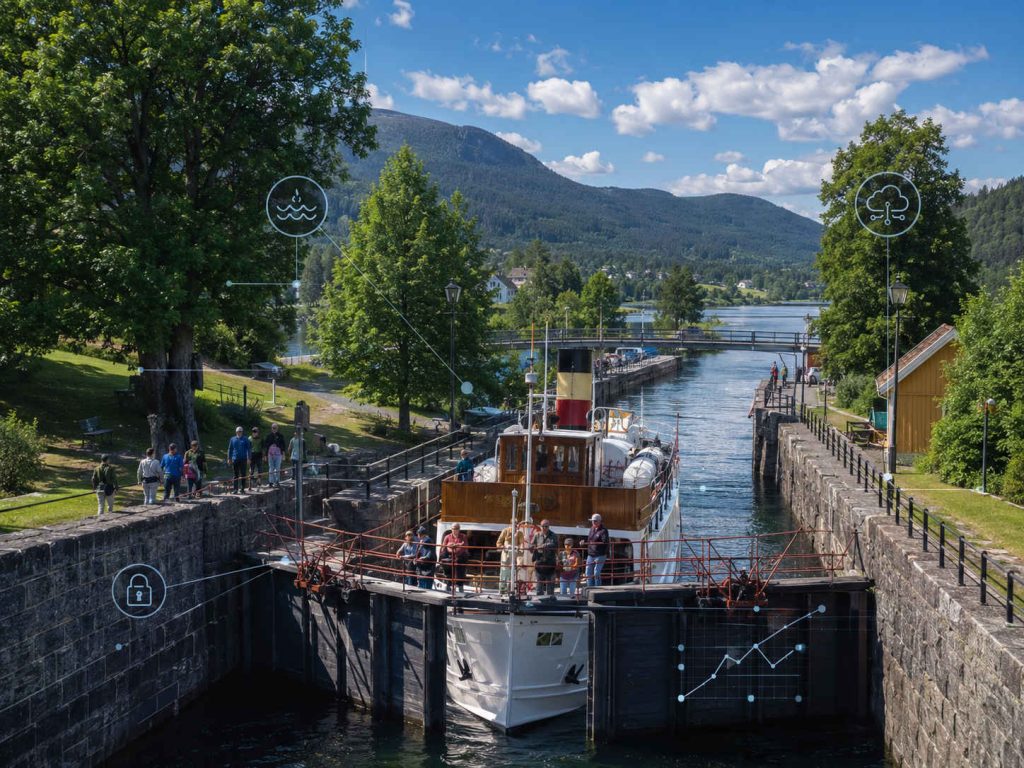
The Norwegian HERITWIN pilot will use the Telemark Canal and the Skien area to test whether digital twin methods can support risk awareness, maintenance planning and predictive conservation in a living cultural landscape.
The Telemark Canal is a useful HERITWIN case because it is not a sealed museum object. It is a working cultural landscape connected to waterways, locks, settlements, tourism, maintenance, public access and regional identity. The official canal information describes a 105-kilometre waterway from Skien to Dalen, with eight lock systems and a total lift height of 72 metres.
The Norwegian pilot will examine preparedness and predictive conservation. In practice, that means testing whether information about the canal environment can be gathered, structured and used when heritage managers need to understand risk, plan maintenance or prepare for changing conditions.
The pilot is expected to work with several data types. Project-related material refers to digital twin development for heritage risk preparedness, AI-based predictive monitoring for humidity, flooding and structural stress, and integration of GIS/BIM, LiDAR and IoT telemetry. These claims should be treated as work-plan elements until the pilot has produced test evidence.
The value will not come from collecting data for its own sake. The test is whether different records can be connected around decisions that matter to the canal environment. Which structures should be inspected more often? Which areas are exposed to flooding or humidity risk? Which maintenance records are reliable enough to inform planning? Which model outputs are only hypotheses and need human review?
Skien gives the pilot a practical local anchor. The city is closely connected to the canal’s history and to the wider heritage landscape addressed by the pilot. It also makes stakeholder work easier to organise around concrete responsibilities: heritage management, maintenance, emergency preparedness, tourism, interpretation and public use.
The pilot will need to balance technical ambition with heritage responsibility. Digital twin work must respect conservation duties, public safety, data governance, institutional capacity and local knowledge. A model that performs well in a project demonstration but cannot be updated by the responsible organisations would not be a sufficient result.
For Hafenstrom, the Norwegian pilot should also feed the project’s cross-pilot learning. The canal case can show what digital twin methods require when heritage is exposed to weather, water, public use and operational constraints. Other pilots will test archive reconstruction, platform validation, micro-climate monitoring and XR interpretation. The project’s European value depends on comparing those results honestly.
Part 1 of the Heritwin project article can be read here: hafenstrom-to-coordinate-heritwin-a-new-european-cultural-heritage
Part 2 of the Heritwin project article can be read here: from-historic-records-to-decision-support-heritwin-project
Part 3 of the Heritwin project article can be read here: can-digital-heritage-workflows-travel-heritwin-project
The HERITWIN project is funded by European Commission through Horizon Europe Cluster 2 2025 Heritage-03