
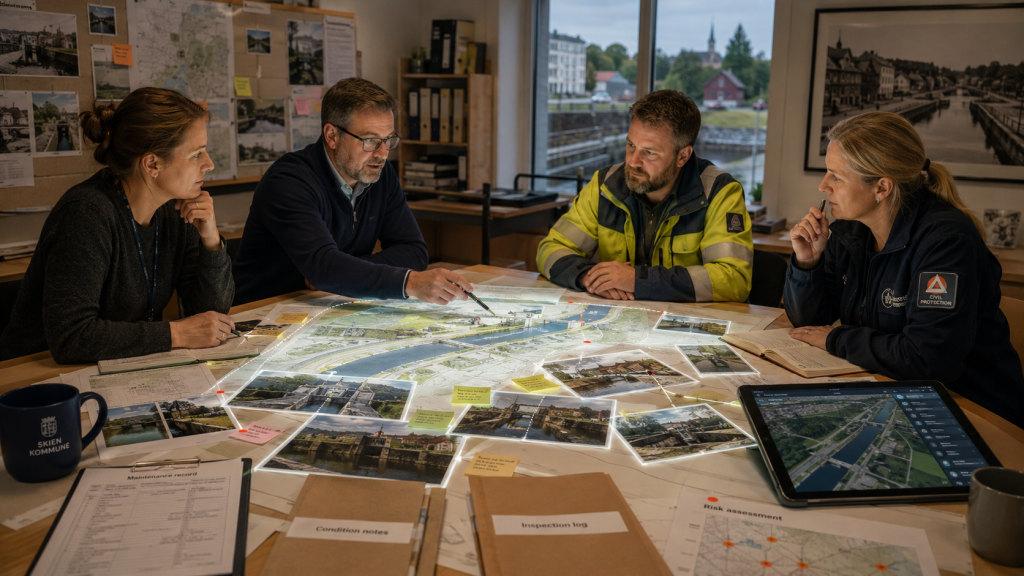
Stakeholder work in Skien should connect the Telemark Canal pilot to the people and organisations that manage, use, interpret and protect the canal as a living heritage environment.
The Norwegian HERITWIN pilot depends on more than technical tools. It depends on local and regional knowledge about the Telemark Canal, the Skien area and the responsibilities attached to a living heritage environment. Skien is the right place to ground that work because the canal is not only a heritage asset; it is also a public space, tourism route, maintenance responsibility and regional story.
The stakeholder process should start with practical questions rather than presentation formats. What information already exists about the canal and its surrounding cultural environment? Which records are reliable, current and reusable? Which datasets are incomplete, sensitive, outdated or held under unclear rights? Where are the main preparedness concerns? Which outputs would help managers, planners, guides, educators or emergency-preparedness actors?
Those questions should influence the pilot before technical choices become too fixed. If local actors need better links between documentation and maintenance planning, the workflow should reflect that. If they need visual material for public communication, that should be separated from operational decision support. If a proposed data source cannot be maintained after the project, the pilot should record that as a constraint rather than hide it.
Stakeholder involvement also reduces a common risk in digital heritage projects: building a technically impressive model that is not embedded in institutional routines. HERITWIN should document who is expected to use each output, what decision or task it supports, which organisation can update it, and what happens if the information becomes outdated.
The Skien work should also contribute to HERITWIN’s wider evidence base. Lessons from the Telemark Canal can be compared with pilots in Sweden, Spain, the United Kingdom and Greece. The Norwegian case may be especially useful for understanding how digital twin methods work in a heritage environment exposed to weather, water, public use and operational constraints.
The strongest editorial claim is therefore modest but important: stakeholder work will not simply “raise engagement”. It should test whether the project is asking the right questions, using maintainable data and producing outputs that responsible organisations can trust after the pilot has ended.
Part 1 of the Heritwin project article can be read here: hafenstrom-to-coordinate-heritwin-a-new-european-cultural-heritage
Part 2 of the Heritwin project article can be read here: from-historic-records-to-decision-support-heritwin-project
Part 3 of the Heritwin project article can be read here: can-digital-heritage-workflows-travel-heritwin-project
Part 4 of the Heritwin project article can be read here: telemark-canal-as-a-test-case-for-preparedness-heritwin-project
The HERITWIN project is funded by European Commission through Horizon Europe Cluster 2 2025 Heritage-03